

The project offers a rich programme of events—talks, workshops, music, theatre, cinema and publishing presentations—which expand upon and deepen the themes of the exhibition, and expresses a profound, solidarity-based commitment of closeness and support from a cultural, international and civic network that is attentive and engaged.
The public and private institutions involved include: Università per Stranieri di Siena, Salone Internazionale del Libro di Torino, Lettera 22 Roma, Museo Nazionale del Cinema di Torino, Riwaq Center for Architectural Conservation, Fondazione MeNo Palermo, Hawaf Collective Paris/Gaza, Libreria Trebisonda Torino, Associazione Festival delle Colline Torinesi, Museo Archeologico Castromediano Lecce, MAO – Museo d’Arte Orientale Torino, PAV – Parco Arte Vivente Torino, Fondazione Lac o Le Mon San Cesario di Lecce, Tedacà Torino, SeSaMO – Società per gli Studi sul Medio Oriente Torino, Dar Yusuf Nasri Jacir for Art and Research, OTO Sound Museum, APS Zenzero – Arci, Vento di Terra ONG.
Salone Internazionale del Libro di Torino has already hosted the event Storia di Gaza, featuring a dialogue between Tomaso Montanari, Christian Greco and Paola Caridi, in conversation with Jean-Pierre Filiu.
In June, contemporary Palestinian sound practices will take centre stage alongside images and writing. The programme continues in July with cinema, talks, theatre, workshops and DJ sets, before concluding in September, maintaining a diverse and participatory schedule that expands the themes of the exhibition.
Among the participants are Majdal Nateel (Dahaleez Collective), Emily Jacir (Dar Yusuf Nasri Jacir for Art and Research), Francesca Ceccherini and Francesca Brusa (OTO Sound Museum), Nabil Bey Salameh, Amjed Rifaie, Tim Slade, Olivier Bourgeois, Jehad Ali Jarbou, and Shayma Hamad, among many others.
The programme, which is continuously evolving, seeks to address the destruction of cultural, human, material and immaterial heritage, and its broader implications.
JULY PROGRAM:
12 July from 3.30 pm (Approximate duration: 4–5 hours) – Parco Arte Vivente (PAV) di Torino
Palestinian Bread-Making Workshop led by Reem and Maysa
Spend an afternoon discovering Palestinian bread-making in a hands-on workshop led by Reem Al Nemnem and Maysa Al Halees, in collaboration with the Associazione Zenzero in Genoa and the Parco Arte Vivente (PAV) in Turin.
During the workshop, participants will learn how to make Arabic bread and manakish, following each step of the process, from preparing the dough to shaping and baking it. The bread will be baked in the Focolare community oven, a participatory installation by the Terra Terra collective, located at PAV and designed as a place for meeting, sharing and making together.
During the afternoon, Reem and Maysa will also demonstrate how to prepare hummus and baba ghanoush, which will be served with the freshly baked bread at the end of the workshop.
No previous experience is required. The workshop is open to everyone and free of charge. Places are limited. To book, please email edu@fondazionemerz.org.
28 July at 9.30 pm – Casa del Quartiere San Salvario, Via Morgari 14, Torino
screening of The destruction of Memory by Tim Slade
the director will be present and will take part in a pre-screening discussion with Christian Greco, Director of the Museo Egizio of Turin.
Over the course of the last century, the destruction of culture has become a global catastrophe. An endless war that has continued into the twenty-first century, showing no sign of ending and instead growing ever more intense. In Syria and Iraq, often described as the cradle of civilisation, thousands of years of cultural heritage have been destroyed. Yet the determination to protect, preserve and rebuild our shared cultural heritage has grown alongside this destruction.
Laws and international policies have played their part, but there have also been individuals who have acted with extraordinary courage, risking and even losing their lives to protect not only other people, but our cultural identity itself.
Based on the book by Robert Bevan, this documentary tells the full story: not only the destruction carried out by Daesh (ISIS), but also the earlier political decisions that kept the issue out of public view for many years. The film combines archive footage with interviews featuring the Director-General of UNESCO, the Prosecutor of the International Criminal Court, and a number of leading international experts.
Original version with Italian subtitles.
Admission: €6.
JUNE PROGRAMME:
4 June, from 6:30 pm
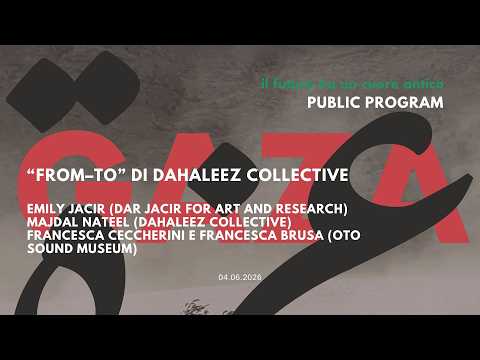
Listening session of the sound piece From–To by Dahaleez Collective
Followed by a conversation between Emily Jacir (Dar Yusuf Nasri Jacir for Art and Research), Majdal Nateel (Dahaleez Collective), Francesca Ceccherini and Francesca Brusa (OTO Sound Museum).
In 2025 OTO Sound Museum and Dar Jacir for Art and Research partnered together to establish the first Palestinian art prize dedicated to sound and listening. The 2025 prize was awarded to Dahaleez Collective, a Gaza-based research art collective whose work sits at the intersection of sound, narrative, and political memory. Dahaleez is a multifaceted sonic-arts archive, collecting field recordings, oral testimonies, and historical material to counter erasure, evoke memory, and open futures. Rooted in Gaza yet resonating globally, Dahaleez create spaces of listening that amplify collective experience.
For the OTO Award x Dar Jacir for Art and Research, Dahaleez produced a new sound piece entitled From-To which testifies and reimagines one of Gaza City’s most vital arteries, Al-Rashid Street. Intertwining past, present, and future in a multidimensional sonic narrative, the piece weaves together sonic fragments, voices, and orchestral compositions to reconstruct the collective memory of the street. The piece draws on sonic matter and reflections gathered during workshops held by Dahaleez collective in 2024-2025, where artists and cultural workers discussed the meaning and memory of the street. Original sounds from personal archives were woven together with music and symbolic sonic gestures to evoke layers of history and lived experience. At its core, the composition includes a musical piece by Mahmoud Abuwarda, originally written during the 11-day war in 2021 and later produced in 2025 with Lisbon Symphonic Orchestra. From–To becomes an auditory journey, an archive of place and time resonating between what was, what is, and what might be.
9 June, from 7:00 pm
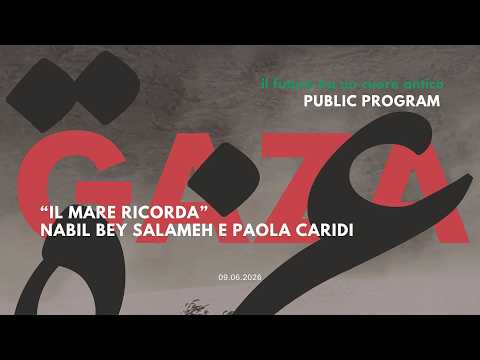
Il mare ricorda (The Sea Remembers) with Nabil Bey Salameh
Music, words and images
A journey through sounds, silences, stories and poetic fragments, inviting audiences to listen to Gaza beyond the image of destruction: as a living place shaped by culture, imagination, layered histories, and human and symbolic resistance.
In a time of rubble and narratives reduced to mere news, Gaza risks being told only through the grammar of destruction. Numbers, ruins, military maps, borders, emergencies.
Gaza, before being the epicentre of a contemporary tragedy, was for millennia a gateway to the Mediterranean. A place of passage and encounter, a port of civilisation, a living archive of languages, trade, music, stories, and human layers. To destroy a city also means trying to break the invisible continuity that links human beings to their places, their dead, their memories, and their sounds.
It means striking at a people’s very right to tell their own story.
Yet, some things resist destruction. The ancient breath of the sea resists. The lullabies of mothers, the lamentations, the cries of the markets, the stories told in homes, the names of vanished villages, the poetry kept in the voice, the stubborn rhythm of daily life—all resist. Beauty resists.
This journey then tries to become an archaeology of listening: a crossing of sonic, literary, and human memories to bring to light not only the pain, but above all the presence. An ancient and living presence, which continues to inhabit the Mediterranean like a restless and necessary conscience.
13 June, from 3:30 pm to 7:00 pm
Calligraphy workshop with Amjed Rifaie
A journey into the heart of Arab culture through calligraphy, one of the highest artistic and spiritual expressions of the Arab world. During the workshop, participants will have the opportunity to learn about the history of Arabic writing, discover the main calligraphic styles, and appreciate the beauty of Arabic letters from a linguistic, cultural, and artistic perspective.
Guided by master calligrapher Amjed Rifaie, originally from Mesopotamia (Iraq), participants will experiment with the traditional handmade bamboo reed pen, learning the gestures and techniques that for centuries have given life to works of great elegance.
Through practical exercises and moments of concentration and meditation, it will be possible to approach an art form that combines creativity, harmony, and self-knowledge, entering into contact with a cultural tradition rich in history and meaning.